Understanding how hedge funds are structured is essential for anyone exploring a career in finance or wanting to understand how institutional investment firms operate behind the scenes. While hedge funds may appear seamless from the outside, their work is divided across three specialised functions: the front office, the middle office, and the back-office. Each handles a different stage of the investment and operational lifecycle, ensuring performance, control and efficiency.
What Is the Front, Middle and Back-Office in a Hedge Fund?
The Three-Layer Structure
- Front office: Revenue-generating and client-facing roles such as portfolio managers, analysts and traders.
- Middle office: Risk management, compliance, valuations, trade support and performance analytics.
- Back-office: Settlements, fund accounting, reconciliation, reporting and administrative operations.
Why Hedge Funds Use This Structure
Segmenting responsibilities:
- Improves risk controls
- Supports regulatory compliance
- Enables specialisation and efficiency
- Reduces operational conflicts of interest
- Ensures accurate, transparent reporting to investors
How the Three Offices Work Together
Front Office → Middle Office → Back-office
- Front Office: Idea → Research → Trade execution
- Middle Office: Risk checks → Trade validation → Exposure monitoring
- Back-office: Settlement → Reconciliation → NAV reporting
Every trade passes through all three offices, each providing oversight, accuracy and accountability.
Front Office Roles in a Hedge Fund
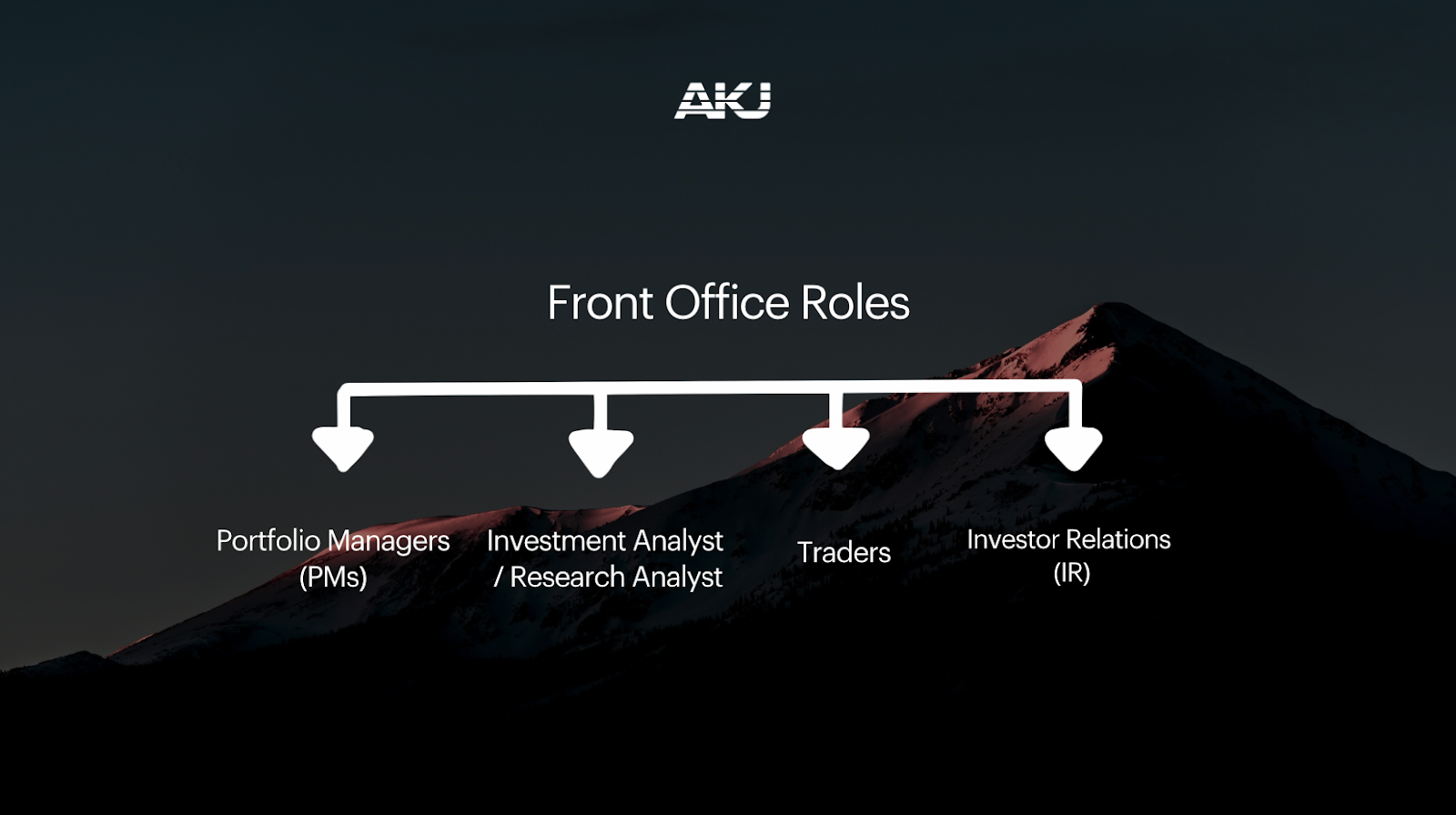
The front office is the commercial engine of a hedge fund. These roles directly contribute to investment performance and are typically the most competitive.
1. Portfolio Managers (PMs)
Responsibility: Oversee investment strategies, construct portfolios, and make final trading decisions.
Key tasks:
- Formulating trade ideas
- Managing risk within strategy mandates
- Monitoring portfolio performance
- Leading analysts and coordinating research
- Communicating results to investors
Skills: Advanced analytical capability, strong judgment, market intuition, deep product knowledge.
2. Investment Analysts / Research Analysts
Responsibility: Support PMs by conducting research and analysis.
Key tasks:
- Building financial models
- Monitoring companies, sectors or macro themes
- Generating trade ideas
- Preparing investment memos
Skills: Financial modelling, sector expertise, strong communication.
3. Traders
Responsibility: Execute trades efficiently while managing market impact and liquidity.
Key tasks:
- Order execution
- Monitoring market depth and liquidity
- Minimising transaction costs
- Maintaining broker relationships
Skills: Fast decision-making, deep market microstructure knowledge, calmness under pressure.
4. Investor Relations (IR)
Responsibility: Maintain communication with investors and support fundraising.
Key tasks:
- Preparing investor updates
- Responding to inquiries
- Handling due diligence processes
- Supporting capital-raising initiatives
Skills: Presentation skills, product knowledge, relationship management.
Middle Office Roles in a Hedge Fund
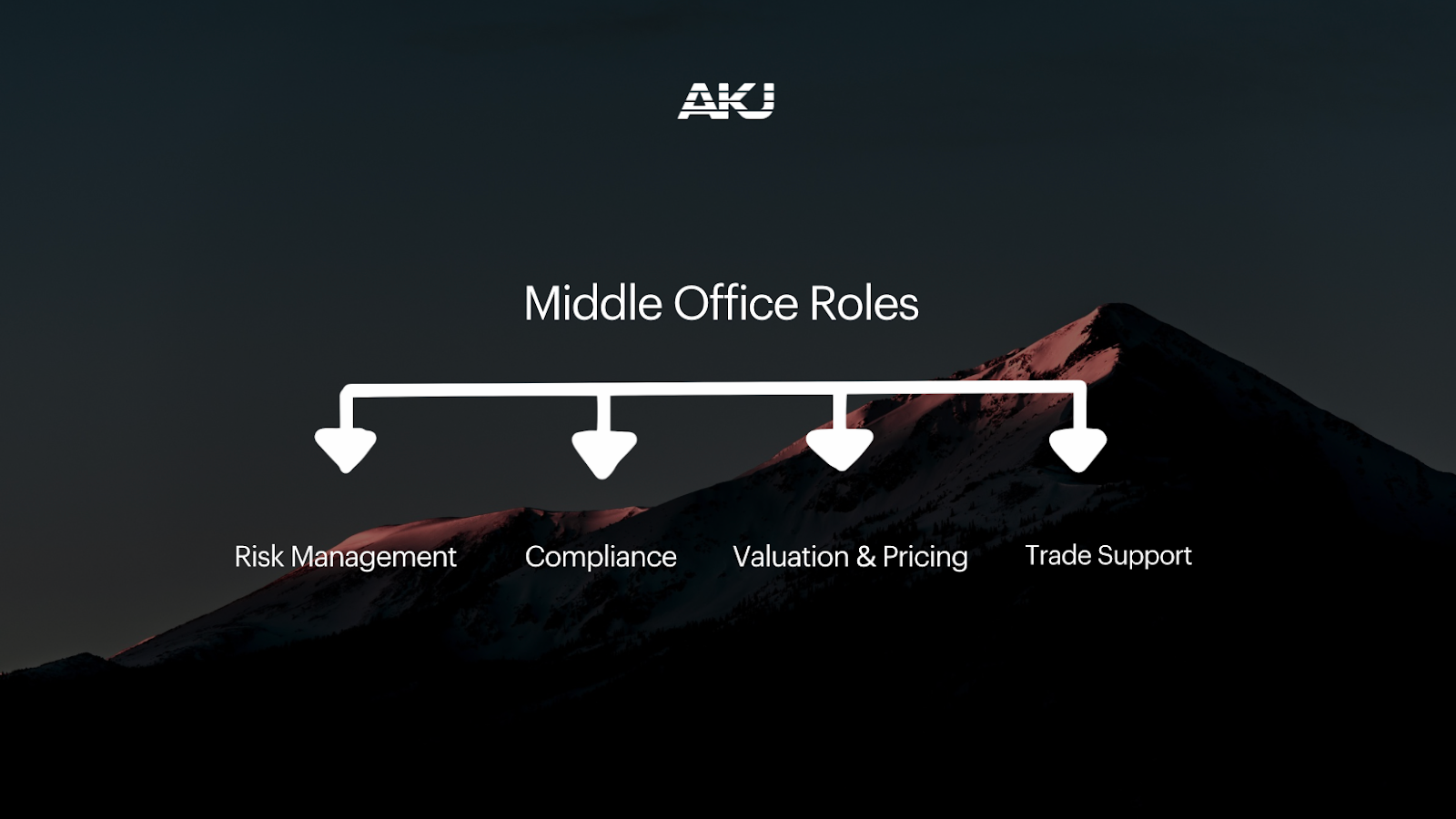
The middle office is the control centre of a hedge fund. It ensures that investment activity is monitored, compliant and properly risk-assessed.
1. Risk Management
Responsibility: Monitor, measure and report risk across portfolios.
Key tasks:
- Stress testing
- VaR and exposure reporting
- Liquidity analysis
- Counterparty risk assessments
Skills: Quantitative modelling, derivatives knowledge, attention to detail.
2. Compliance
Responsibility: Ensure regulatory adherence and prevent misconduct.
Key tasks:
- Pre- and post-trade compliance
- Monitoring for market abuse
- Reviewing marketing materials
- Interpreting regulations (FCA, AIFMD, MiFID)
Skills: Regulatory knowledge, detail orientation, communication.
3. Valuation & Pricing
Responsibility: Ensure assets are priced accurately and independently.
Key tasks:
- Independent price verification
- Oversight of NAV calculations
- Managing valuation disputes
Skills: Understanding of pricing models, coordination with administrators.
4. Trade Support
Responsibility: Ensure trades are booked, confirmed and supported operationally.
Key tasks:
- Trade capture and confirmation
- Resolving breaks
- Liaising with brokers and custodians
Skills: Systems proficiency, issue resolution, time-sensitive coordination.
Back-office Roles in a Hedge Fund
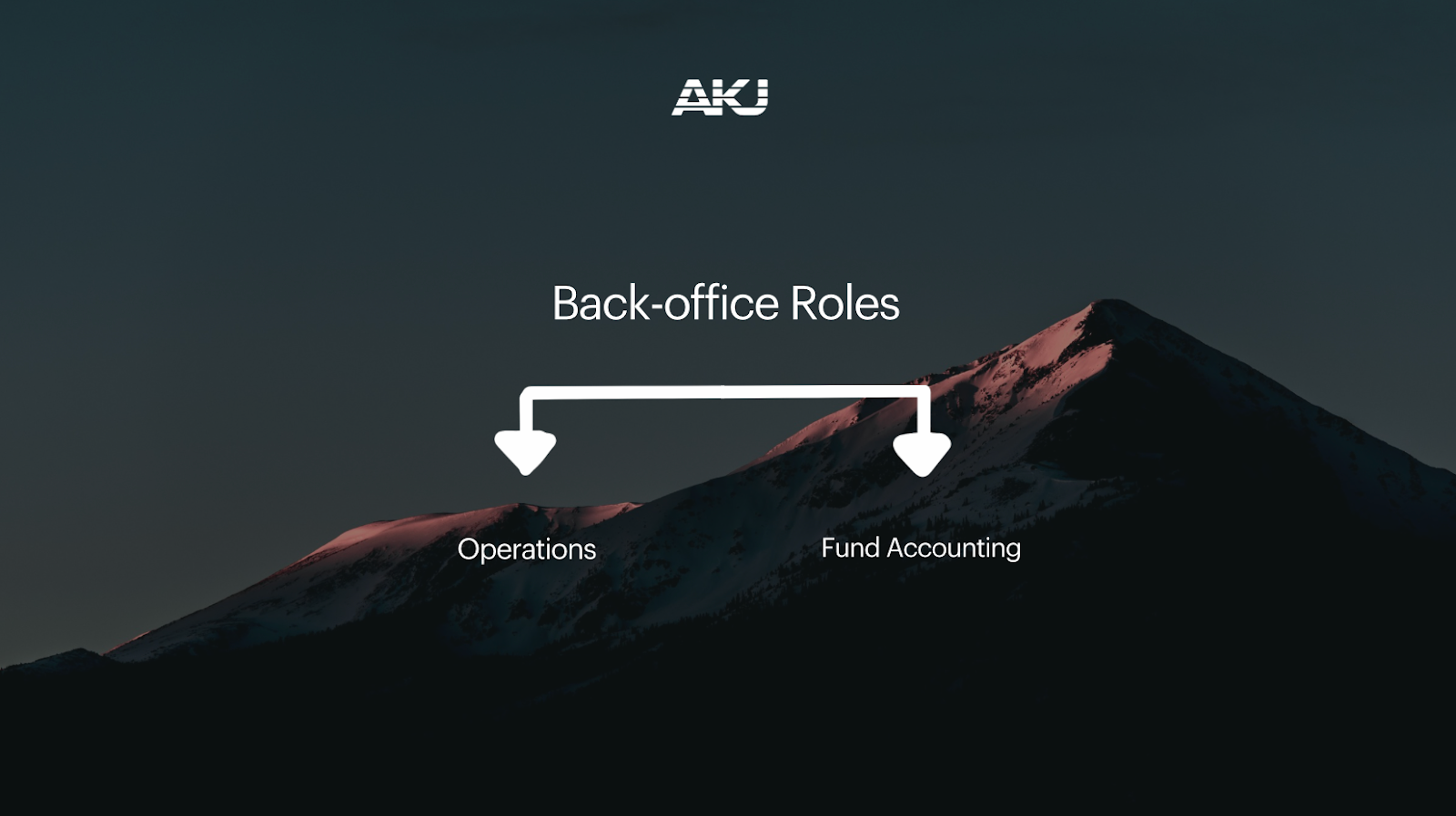
The back-office handles the machinery that keeps the hedge fund functioning day-to-day, ensuring accuracy, stability and accountability.
1. Operations
Responsibility: Oversee the post-trade lifecycle and operational processes.
Key tasks:
- Settlements and confirmations
- Corporate actions
- Collateral management
- Cash and position reconciliation
Skills: Organisation, systems knowledge, accuracy.
2. Fund Accounting
Responsibility: Maintain books and records and oversee financial reporting.
Key tasks:
- NAV calculations
- Expense accruals
- Financial statements
- Audit coordination
Skills: Accounting knowledge, numerical precision, ability to work with administrators.
Front Office vs Middle Office vs Back-office: Key Differences
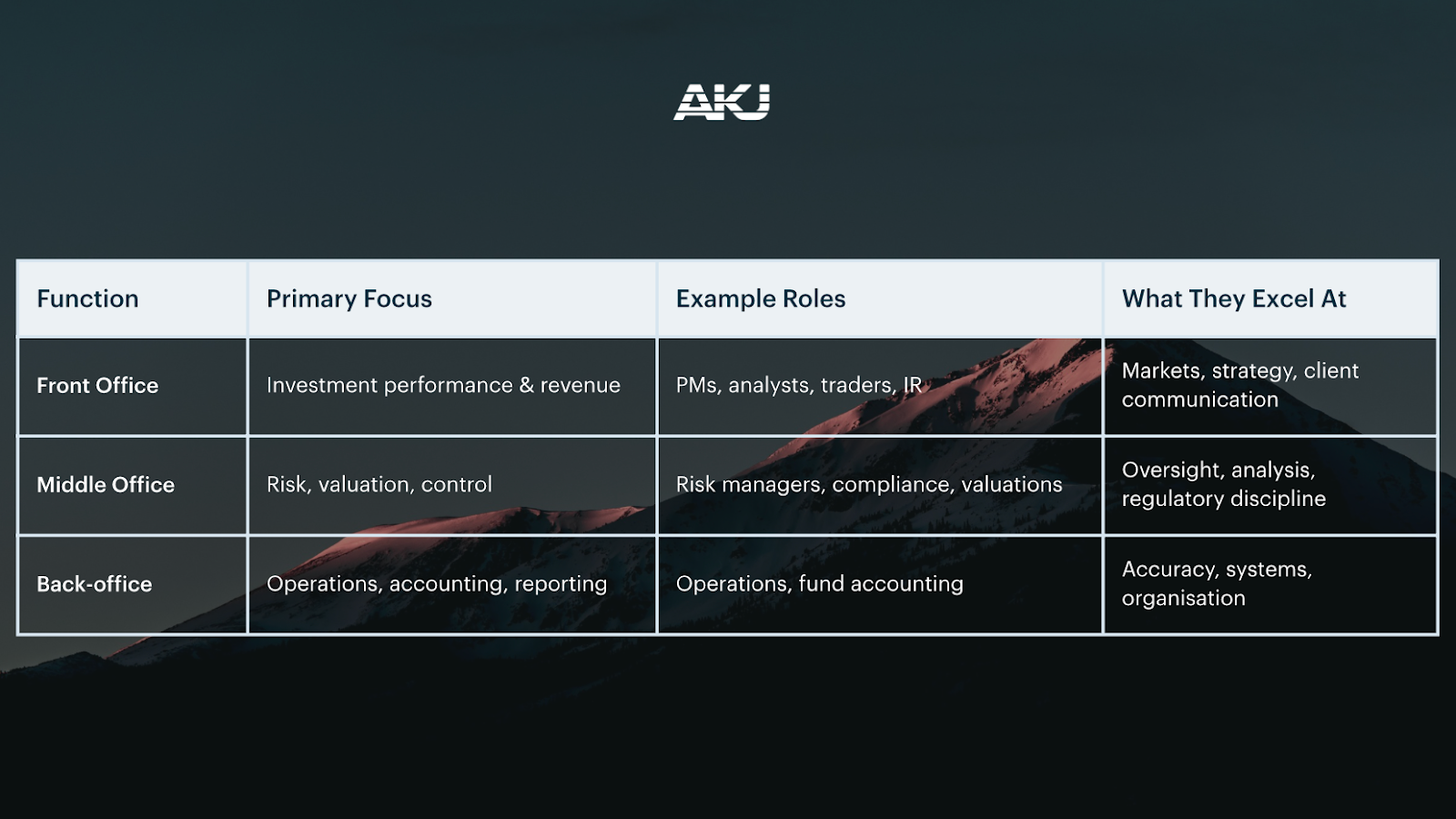
Each office contributes to performance, control and operational excellence in different ways.
Career Mobility Between Offices
Career transitions are common, though some routes are more competitive than others.
Back-office → Middle Office
Very common. Professionals often progress by:
- Building product knowledge
- Participating in valuation or risk projects
- Strengthening technical skills (Excel, Python, Bloomberg systems)
Middle Office → Front Office
Possible but demanding. Success usually requires:
- Strong modelling and analytical ability
- Deep product knowledge
- Networking and visibility with front-office teams
Typical transition routes:
- Risk → Execution trading
- Performance analysis → Quantitative research
Front Office → Middle/Back-office
Less common, but can happen when:
- Seeking more predictable hours
- Moving into governance or oversight roles
- Transitioning into operational leadership
How to Choose the Right Hedge Fund Career Path
Choose based on your strengths, interests and long-term goals.
If you enjoy:
- High-pressure decision-making + markets → Front office
- Quantitative analysis + oversight → Middle office
- Process optimisation + accuracy → Back-office
- Regulation + policy interpretation → Compliance
- Accounting + financial reporting → Fund accounting
Work–Life Balance Considerations
- Front office: Most demanding
- Middle office: Moderate
- Back-office: Generally the most structured
Interested in advancing your career in hedge funds — whether in investment, risk or operations?
- Learn more about our hedge fund platform
- Explore current career opportunities
- Check out our summer internship