Crypto staking is the process of locking up cryptocurrency to help secure a proof-of-stake blockchain network — and being rewarded for doing so. It is one of the main ways holders of digital assets earn a yield without selling.
Staking is the proof-of-stake equivalent of mining. Instead of computers competing to solve puzzles, validators put their own crypto on the line as a guarantee of honest behaviour. In return, they earn rewards paid out by the network.
What does staking crypto mean?
Staking crypto means committing tokens to a blockchain network so they can be used to validate transactions and produce new blocks. While staked, the tokens are typically locked or restricted from being moved.
Only blockchains that use a proof-of-stake (PoS) consensus mechanism support staking. Bitcoin uses proof-of-work and cannot be staked. Ethereum, Solana, Cardano, and most newer networks use proof-of-stake.
In simple terms: staking is the network paying you to help keep it secure.
How does crypto staking work?
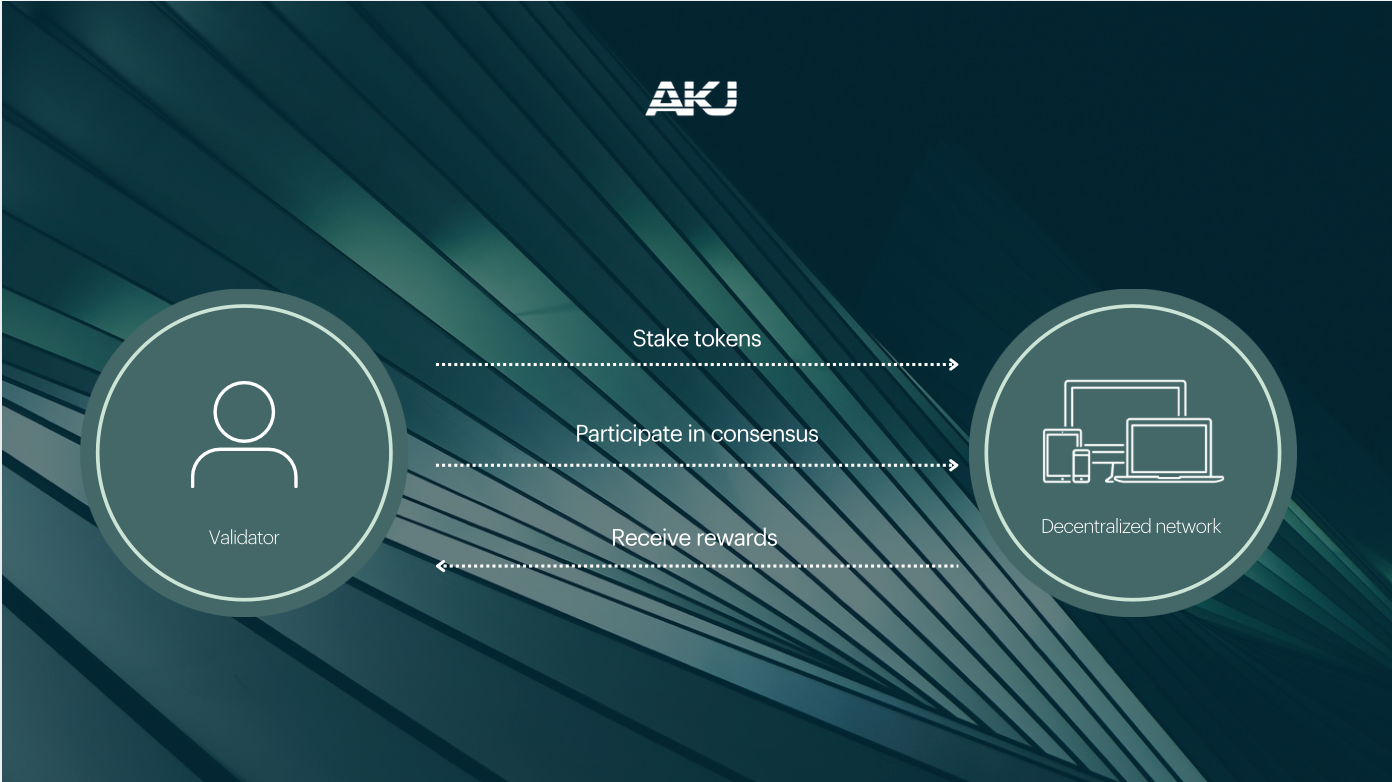
On a proof-of-stake network, validators are chosen to confirm new transactions and add them to the blockchain. To become a validator — or to support one — a participant must lock up a minimum amount of the network's native token. That locked amount is the validator's stake.
If a validator behaves honestly and stays online, the network rewards them with newly issued tokens and a share of transaction fees. If they misbehave or go offline, part of their stake can be taken away. This penalty is called slashing.
A typical staking flow looks like this:
- Choose a proof-of-stake asset (e.g. Ethereum, Solana, Cardano).
- Decide whether to run a validator yourself, delegate to one, or use a staking service.
- Lock up the required tokens — directly on the network or through a platform.
- The validator confirms transactions and earns rewards.
- Rewards are distributed to you, usually in the same token you staked.
Most retail users do not run their own validator — they delegate to one or stake through an exchange or custody platform that handles the technical work on their behalf.
Why do people stake crypto?
Staking serves two purposes at once.
For the network: it secures the blockchain. The more tokens staked, the more expensive an attack becomes — an attacker would need to buy and stake a controlling share of the network’s tokens, and if they tried to cheat, the network would destroy that stake through slashing.
For the staker: it generates yield on assets that would otherwise sit idle. For long-term holders who do not plan to sell, staking provides a way to earn a return while still holding the underlying asset.
Common reasons people stake:
- Earn passive rewards on long-term holdings.
- Support a blockchain network they believe in.
- Avoid the energy costs and hardware of proof-of-work mining.
- Compound returns over time by re-staking rewards.
How are staking rewards calculated?
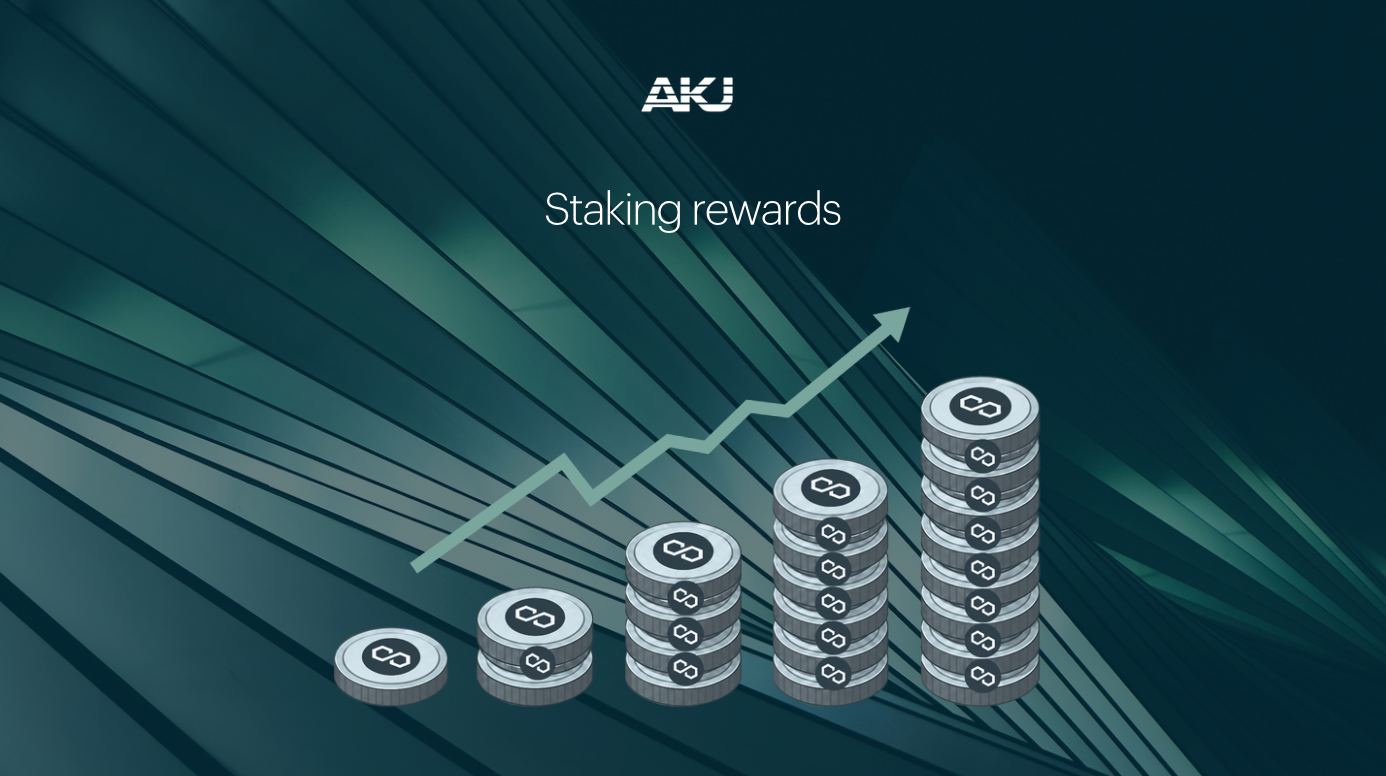
Staking rewards are usually expressed as an annual percentage yield (APY) — the estimated return over one year if rewards continue at the current rate.
The actual yield depends on several factors:
- The network's issuance rate (how many new tokens are created and given to stakers).
- The total amount of tokens staked across the network. The more tokens staked, the smaller each individual share.
- Validator performance. Offline or under-performing validators earn less.
- Commission charged by the validator or platform you stake through.
A typical APY ranges from around 3% to 8% on major networks like Ethereum and Solana, but it varies by asset and changes over time. Smaller networks sometimes advertise much higher yields, but those are usually offset by token inflation, lower liquidity, and higher risk.
Important: an APY is denominated in the token you stake. If the token's price falls 30%, an 8% staking yield does not protect you from that loss.
What can you stake?
Only proof-of-stake assets can be staked. The most widely staked tokens include:
- Ether (ETH) — the native token of Ethereum, the largest proof-of-stake network.
- Solana (SOL) — a high-throughput proof-of-stake blockchain.
- Cardano (ADA) — delegated proof-of-stake, designed for low barrier to entry.
- Polkadot (DOT) — uses a nominated proof-of-stake model.
- Cosmos (ATOM), Avalanche (AVAX), Tezos (XTZ) — other established proof-of-stake networks.
Bitcoin cannot be staked because it uses proof-of-work. Stablecoins generally cannot be staked either, though some platforms offer yield products on stablecoins that work differently and carry different risks.
Different types of crypto staking
Staking is not a single activity. There are several ways to participate, each with different trade-offs between control, yield, and risk.
Solo staking (running your own validator)
You operate the validator software yourself and lock up the full minimum stake (32 ETH on Ethereum, for example). You earn the full reward but take on the technical and operational risk — uptime, key management, slashing.
Delegated staking
You assign your tokens to a validator who runs the infrastructure on your behalf. You keep ownership of the tokens; the validator takes a commission from the rewards. This is the standard model on networks like Cardano, Solana, and Cosmos.
Exchange staking
You stake through a centralised exchange such as Coinbase, Kraken, or Binance. The exchange handles all the technical work and pays you a share of the rewards. Convenient — but you give up custody of the tokens, and the exchange takes a meaningful cut.
Liquid staking
You stake through a protocol that gives you a tradable token representing your staked position (for example, stETH from Lido). You earn staking rewards while still holding a liquid asset you can use elsewhere in DeFi. Liquid staking introduces additional smart contract risk and the possibility that the liquid token trades at a discount to the underlying.
Institutional staking
For funds and corporate treasuries, staking is typically run through a regulated infrastructure provider that integrates with the institution's custody setup. Tokens remain in qualified custody throughout, validator operation is delegated to a specialist, and reporting is built for fund administration. This is how AKJ approaches staking for clients.
Risks of crypto staking
Staking is not risk-free. Anyone considering it should understand the main risks before committing capital.
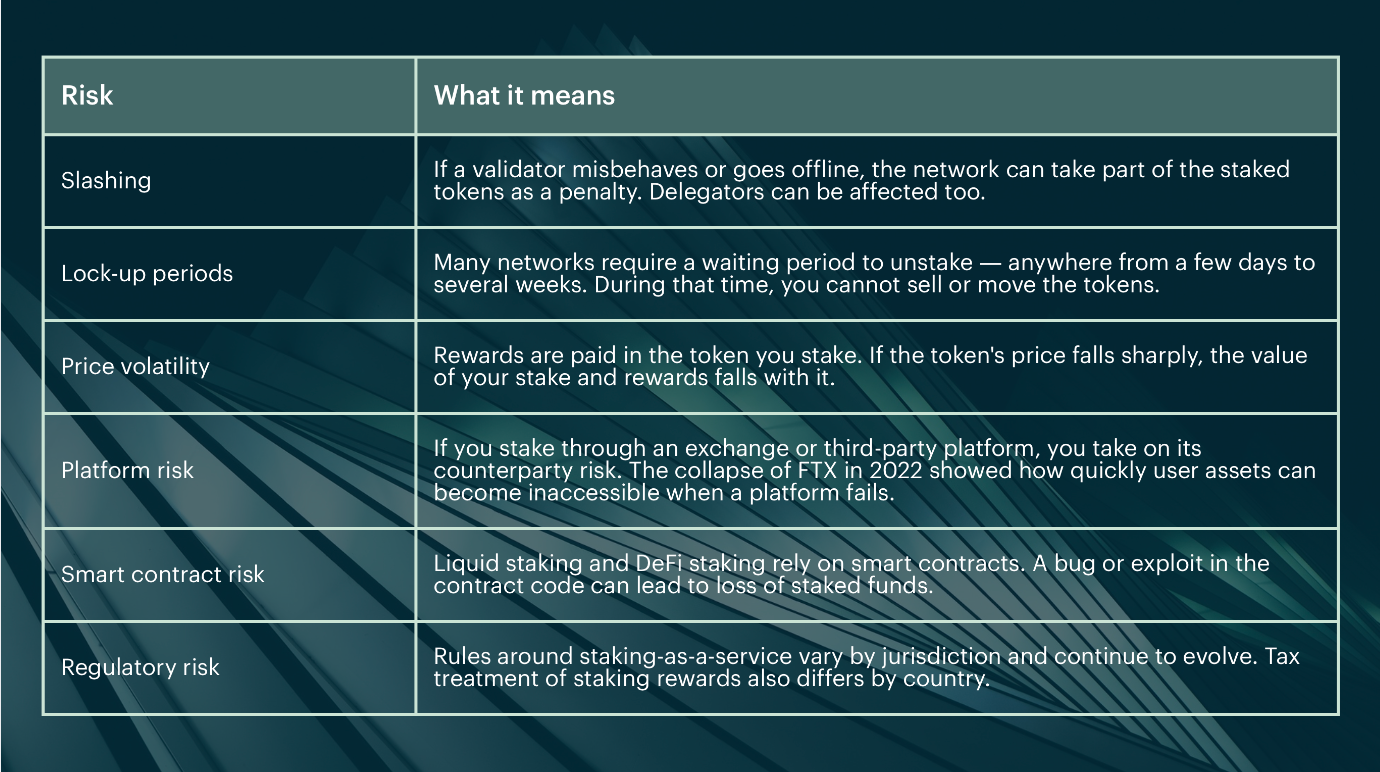
In the UK, HMRC generally treats staking rewards as taxable income at the point they are received, with subsequent disposals subject to capital gains tax. Specific treatment depends on the circumstances and you should seek independent tax advice.
Staking vs mining vs trading: what's the difference?
Staking, mining, and trading are three different ways of generating returns from crypto. They are not interchangeable.
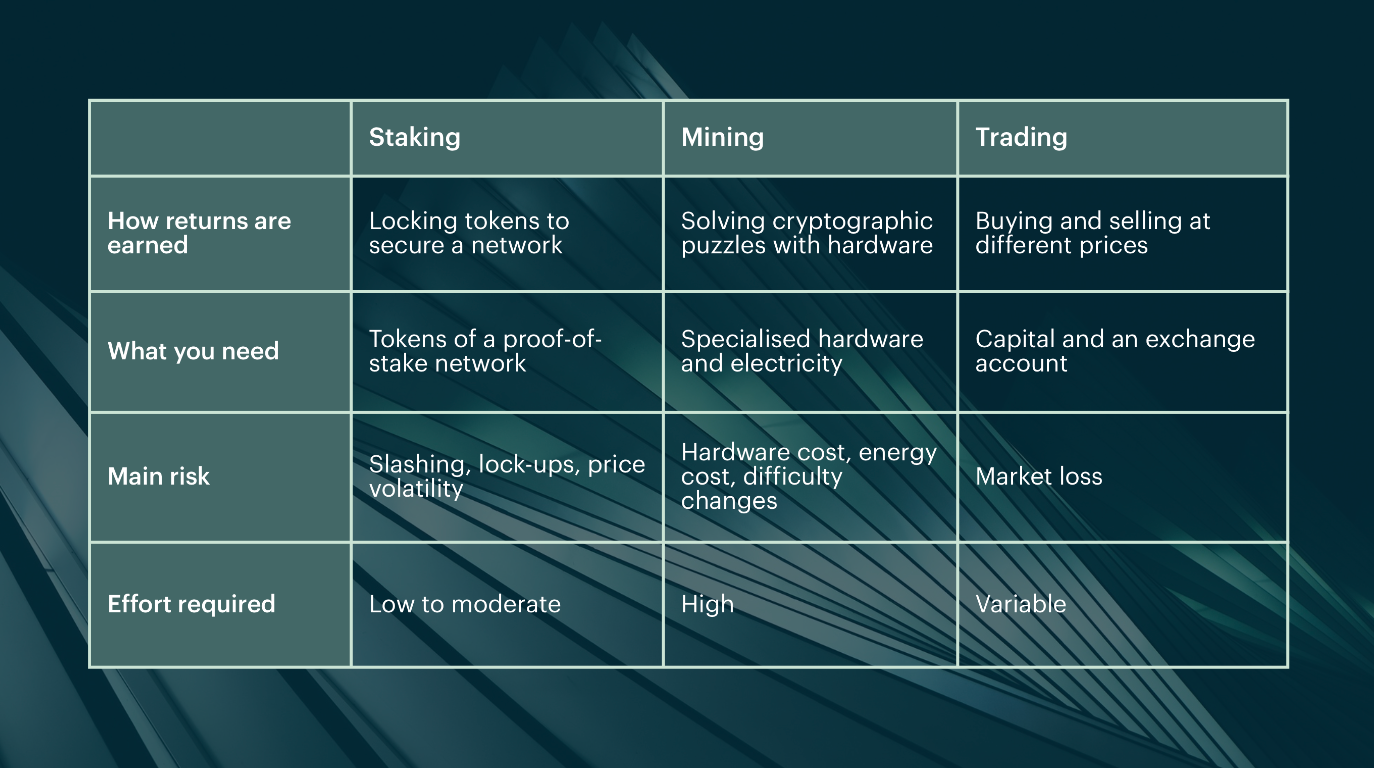
Staking is closer in spirit to earning interest on a long-term holding than to active trading. It rewards holders who are willing to commit their tokens to the network for an extended period.
For background on what crypto is in the first place, read What is Cryptocurrency.
Summary
Staking crypto means locking up tokens to help secure a proof-of-stake blockchain in exchange for rewards. It offers a way for long-term holders to earn yield on assets they would otherwise hold passively, and it plays a structural role in keeping the underlying networks operational.
Rewards are real but not guaranteed, and the risks are concrete: slashing, lock-up periods, platform failures, and the price volatility of the underlying asset. The right approach depends on how much technical responsibility, custody risk, and liquidity constraint you are willing to accept.
For institutional participants, staking is increasingly an infrastructure question rather than a retail one — handled through qualified custody, regulated providers, and integrated reporting.
Learn more
- Learn more about our Digital Asset Fund Platform (AKJ website).
- Read about What is Cryptocurrency (AKJ blog).
- Read more about AKJ (AKJ website).
Disclaimer: This article is for informational purposes only and does not constitute financial advice. Cryptocurrency is a high-risk asset class — values can fall as well as rise, and you may lose all of the money you invest. Crypto holdings are not protected by the Financial Services Compensation Scheme (FSCS).