What Does “Hedge Fund Strategies” Mean?
A hedge fund strategy is a structured investment approach used by hedge funds to generate returns through specialised techniques such as long/short investing, arbitrage, macro positioning, and event-driven trades.
In simple terms, hedge fund strategies define how a hedge fund seeks to make money.
If you’re new to the topic, a hedge fund is a pooled investment vehicle typically available to institutional and professional investors. Unlike traditional mutual funds, hedge funds have broader flexibility in their investment mandate, including the use of leverage, derivatives, and short-selling, in pursuit of excess returns.
Explore our Hedge Fund Platform
Hedge Fund Strategies Explained
Hedge fund strategies are systematic methods designed to exploit market inefficiencies, manage risk dynamically, and produce returns in various economic conditions.
They differ from conventional investment approaches because they:
- Can profit from falling markets
- Use derivatives and leverage
- Focus on relative value rather than just direction
- Often aim for risk-adjusted returns rather than raw growth
The term “hedge” originally referred to reducing market exposure. Today, however, many hedge fund strategies go far beyond simple hedging.
What Is a Hedge Fund Strategy?
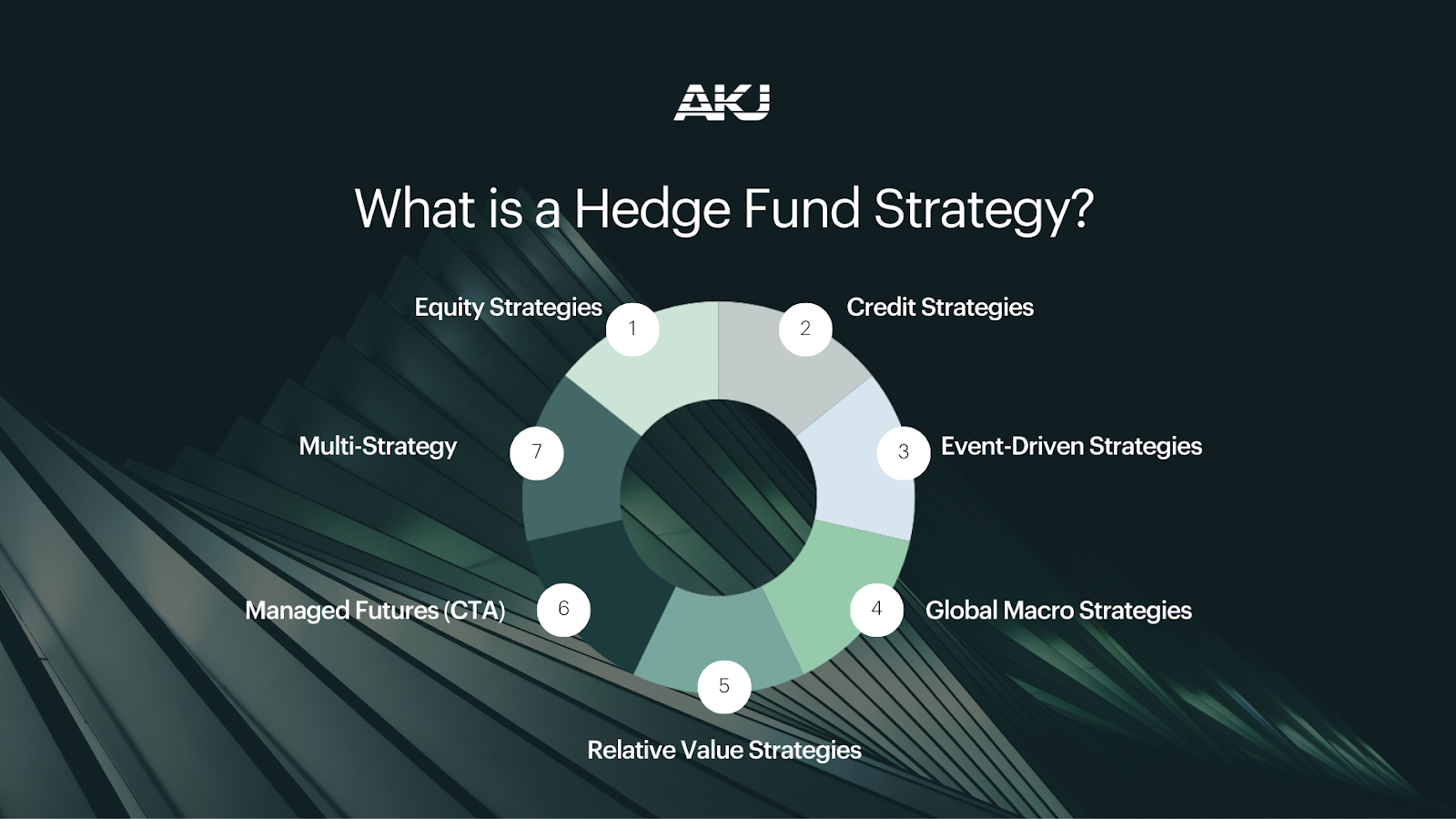
A hedge fund strategy is the specific framework a fund manager uses to identify opportunities, manage risk, and allocate capital, with the objective of generating alpha — excess returns attributable to manager skill rather than overall market movement.
Hedge funds are typically grouped into several primary strategy categories based on return drivers, asset focus, and implementation style. While sub-strategies vary, most fall within the following core groups:
1. Equity Strategies
Invest primarily in publicly listed equities, often combining long and short positions to generate alpha through stock selection while managing or reducing overall market exposure.
Common sub-strategies:
- Equity Long/Short
- Equity Market Neutral
- Sector-focused equity
- Short bias
Primary return driver: Relative performance between selected securities.
2. Credit Strategies
Invest in corporate debt and other credit instruments across the capital structure to capture yield, exploit credit mispricing, and participate in restructuring or distressed situations.
Common sub-strategies:
- Distressed debt
- High-yield credit
- Structured credit
- Credit Long/Short
Primary return driver: Changes in credit spreads and recovery outcomes.
3. Event-Driven Strategies
Target opportunities created by corporate actions and structural changes, seeking to exploit temporary pricing inefficiencies related to mergers, restructurings, or other event-driven situations.
Common sub-strategies:
- Merger arbitrage
- Special situations
- Distressed restructurings
- Activist investing
Primary return driver: Outcomes of corporate transactions and events.
4. Global Macro Strategies
Take positions based on macroeconomic trends and policy developments across global markets to profit from interest rate shifts, inflation dynamics, currency movements, and geopolitical developments.
Common sub-strategies:
- Discretionary macro
- Systematic macro
- Currency strategies
- Rates strategies
Primary return driver: Broad economic and policy-driven market movements.
5. Relative Value Strategies
Exploit pricing discrepancies between related securities to generate risk-adjusted returns with limited directional market exposure.
Common sub-strategies:
- Convertible arbitrage
- Fixed income arbitrage
- Statistical arbitrage
- Capital structure arbitrage
Primary return driver: Convergence of valuation spreads.
6. Managed Futures (CTA)
Systematically trade futures contracts across asset classes to capture price trends and provide diversification during volatile or trending market environments.
Common sub-strategies:
- Trend-following
- Short-term trading models
- Quantitative systematic macro
Primary return driver: Momentum and sustained market trends.
7. Multi-Strategy
Allocate capital across multiple internal hedge fund strategies within one platform to diversify return sources and actively manage risk across market environments.
Common sub-strategies:
- Equity, credit, and macro combinations
- Relative value and event-driven sleeves
Primary return driver: Dynamic capital allocation and diversification.
Comparing Strategy Outcomes
Below is a simplified comparison:
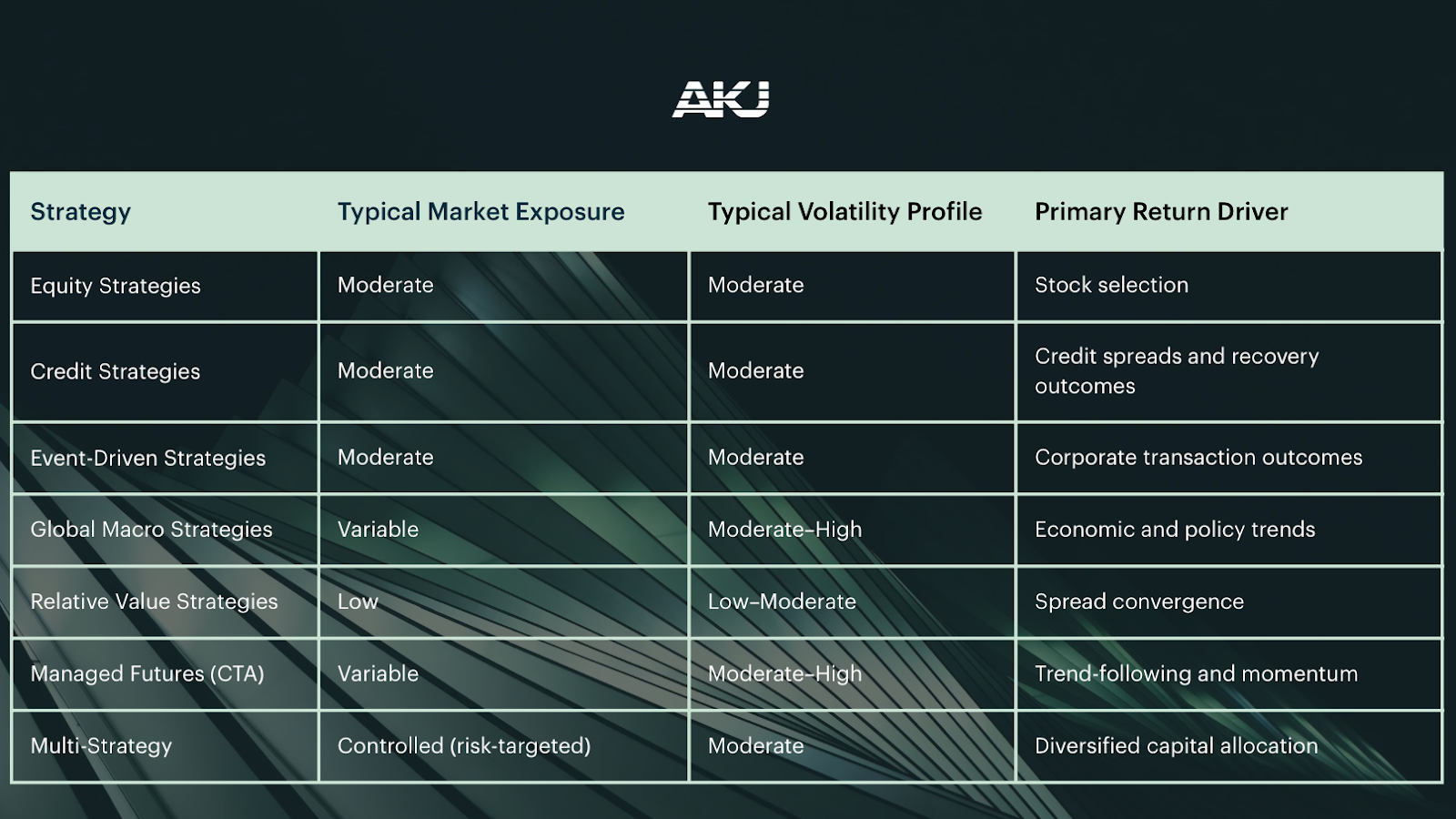
There is no universal “best hedge fund strategy”, performance depends on market conditions, execution skill, and risk controls.
How Strategies Differ in Practice
Although hedge fund strategies are grouped into categories, implementation varies significantly. Two managers using the same strategy can produce very different outcomes due to:
- Position sizing and leverage
- Liquidity management
- Risk controls
- Time horizon
- Use of derivatives
- Portfolio concentration
Strategy classification explains the return driver. Execution determines the outcome.
Common Hedging Techniques Used by Hedge Funds
Hedge funds use a range of instruments to manage risk and control unwanted exposures. The choice depends on liquidity, cost, time horizon, and the type of risk being hedged.
Short-selling involves borrowing and selling a security to profit from a decline. It provides direct downside exposure but carries borrowing costs and theoretically unlimited loss risk.
Put options provide the right to sell at a fixed price. They offer defined downside risk (limited to the premium paid) but are subject to time decay.
Futures and swaps are widely used to adjust market, interest rate, credit, or currency exposure efficiently without trading underlying assets.
Hedging is not tied to one instrument — it is a structural part of how hedge funds manage portfolio risk across strategies.
What Strategy Should You Choose?
There is no single best hedge fund strategy — only strategies aligned with objectives and conditions.
Key considerations include:
- Market volatility
- Economic cycle
- Liquidity environment
- Risk tolerance
- Operational infrastructure
- Technology capabilities
Different environments favour different strategies, for example:
- Strong equity dispersion may benefit Equity Long/Short
- Credit dislocations may favour distressed strategies
- Inflationary or policy shifts may benefit Macro
- Stable, range-bound markets may favour Relative Value
- Sustained trends may favour Managed Futures
Diversification across strategies is common in institutional portfolios.
The Role of Infrastructure
As strategies increase in complexity, operational infrastructure becomes critical.
Modern hedge funds rely on:
- Integrated risk analytics
- Real-time portfolio monitoring
- Data aggregation across asset classes
- Independent valuation and reconciliation
- Robust compliance and reporting systems
Execution quality, transparency, and risk control are often as important as strategy selection.
Why Strategy and Technology Must Align
Even the best strategy fails without disciplined execution.
Modern hedge funds depend on:
- Integrated risk analytics and exposure monitoring
- Real-time portfolio and performance reporting
- Order and execution management systems (OMS/EMS)
- Data integration across asset classes and counterparties
- Independent valuation, reconciliation, and NAV oversight
- Robust compliance and regulatory reporting
Execution quality, transparency, and risk control are often as important as strategy selection.
Explore how AKJ supports hedge funds through its platform.
Is your technology keeping up with your strategy? Request a demo.
Key Takeaways
- Hedge fund strategies are grouped into core categories based on return drivers.
- Equity and Credit strategies represent a large portion of industry assets.
- Event-Driven and Relative Value strategies target specific inefficiencies.
- Macro and Managed Futures provide exposure to broader economic and trend-based dynamics.
- Multi-Strategy platforms aim to combine return sources within a single structure.
- There is no universal “best” approach — context and execution matter.
Final Thoughts
Hedge fund strategies are not simply aggressive investing techniques — they are disciplined frameworks designed to manage risk while identifying opportunity.
Understanding how they work is the first step.
Executing them effectively is the real challenge.
If you're building or scaling a hedge fund operation, infrastructure matters as much as investment insight.
Want to learn more about AKJ and the infrastructure we provide?
- Subscribe to the AKJ newsletter
- Explore more insights on our blog
Are you interested in setting up your own Hedge Fund? Get in touch to see how we can support hedge fund managers and what our platform provides by clicking here