
A hedge fund is a privately managed investment fund that pools capital from eligible investors and deploys it using a broad range of investment strategies to pursue returns across different market conditions.
Hedge funds typically form part of a wider category of vehicles known as alternative investment funds (AIFs). Unlike traditional investment funds, hedge funds can invest across a variety of global asset classes, including equities, fixed income instruments, commodities, derivatives, and real assets such as property. They typically enjoy a high degree of flexibility in how capital is allocated and managed. As a result, hedge funds may employ complex trading strategies, maintain highly concentrated portfolios, or make extensive use of leverage.
An industry definition contained in the Alternative Investment Management Association's (AIMA) roadmap1 to hedge funds describes a hedge fund as:

From a regulatory perspective, hedge funds typically fall within the scope of the Alternative Investment Fund Managers Directive (2011/61/EU) (AIFMD). The AIFMD was transposed in the UK and subsequently domesticated following the UK’s departure from the European Union through the Alternative Investment Fund Managers Regulations 2013 (SI 2013/1773) (UK implementation of the Alternative Investment Fund Managers Directive).
Hedge Funds Explained
A hedge fund is an alternative investment vehicle that is generally intended for professional or sophisticated investors. While objectives vary depending on the strategy adopted, hedge funds commonly aim to generate positive returns in a range of market environments, rather than simply tracking a benchmark. Actual performance, however, will depend on both market conditions and the specific investment approach employed.
Hedge funds are not designed for retail investors. Access is typically limited to institutional investors such as pension funds, insurance companies, and endowments, as well as high-net-worth individuals who meet applicable eligibility requirements or sophistication criteria.
At a high level, a hedge fund brings together three core elements:
- Investors, who provide capital
- A hedge fund manager, who makes investment decisions
- A legal and operational structure, which sets out how the fund operates
How Hedge Funds Work
A hedge fund operates by pooling investor capital and investing it in accordance with a defined investment mandate. The implementation of that mandate is generally entrusted to a hedge fund manager, who exercises discretion over portfolio construction and trading activity within agreed parameters.
The hedge fund manager is typically responsible for:
- Selecting and managing investments
- Monitoring and managing risk and market exposure
- Executing trades and overseeing portfolio adjustments
- Ensuring that the fund operates in compliance with applicable legal and regulatory requirements
Depending on the fund’s structure, additional service providers may include administrators, custodians, prime brokers, auditors, and legal advisers, all of whom support the ongoing operation of the fund
Types of Hedge Funds
Hedge funds are commonly categorised by reference to their primary investment strategy. While individual funds may combine multiple approaches, the following categories are frequently used to describe hedge fund strategies:
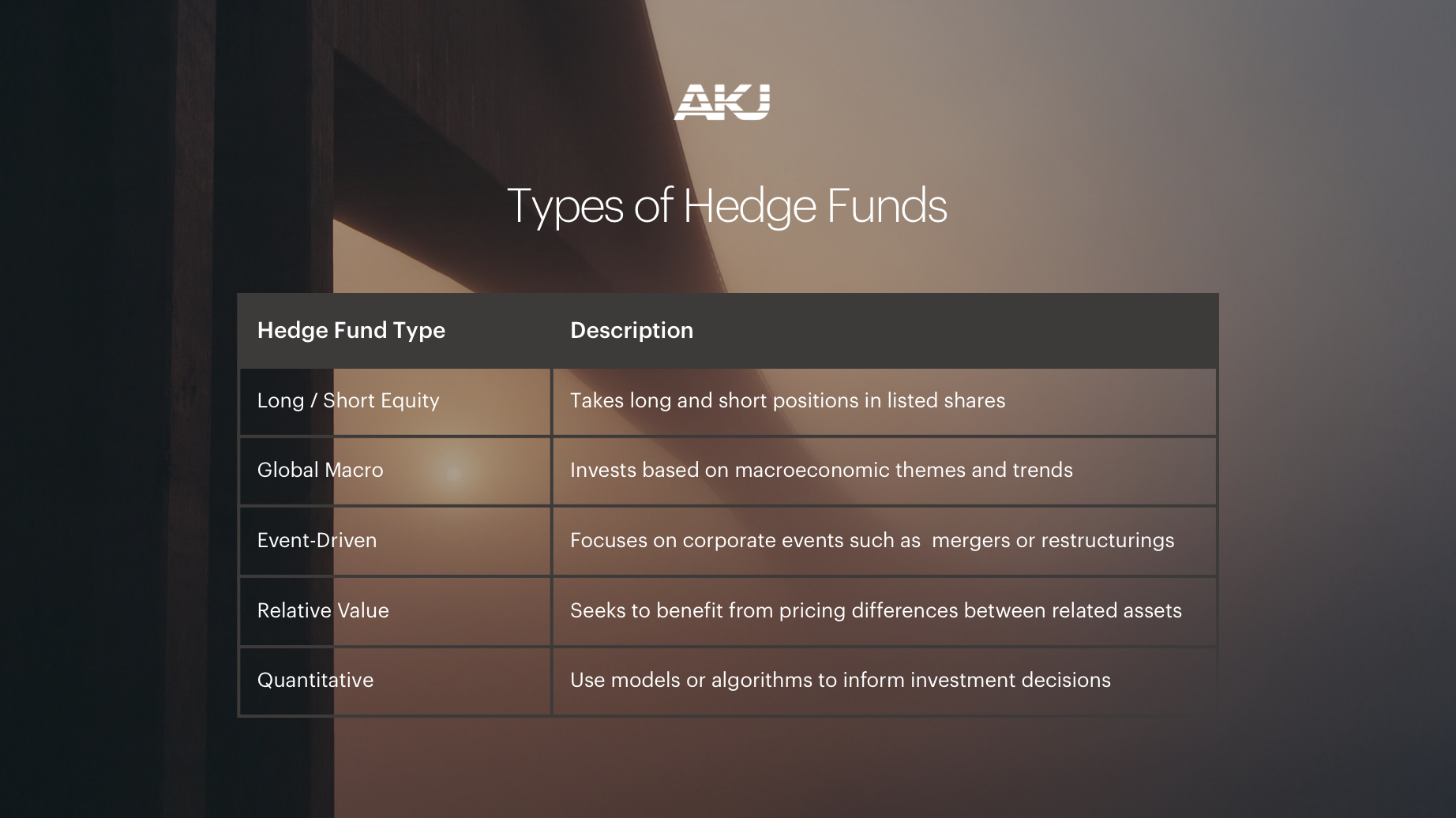
Each of these categories can involve distinct risk profiles, time horizons, and return expectations. As a result, the strategy adopted by a hedge fund is a key consideration for prospective investors.
Hedge Fund Strategies
Depending on its mandate, a hedge fund may employ one or more of the following techniques:
- Short selling, which seeks to profit from declining asset prices
- Leverage, which increases market exposure through borrowing or derivatives
- Derivatives, such as options, futures, or swaps, to manage risk or enhance returns
- Active trading across multiple asset classes and markets
The ability to combine these techniques within a single investment vehicle is a defining characteristic of hedge funds and contributes to their flexibility relative to more traditional fund structures.
What is the Difference Between Hedge Funds and Mutual Funds?
Hedge funds and mutual funds differ in their structure, regulatory treatment, and investment approach.
A mutual fund is a regulated investment product designed for distribution to a broad investor base, including retail investors. It typically offers diversified exposure to asset classes such as equities or bonds and is subject to detailed rules governing risk, liquidity, and disclosure.
Key differences
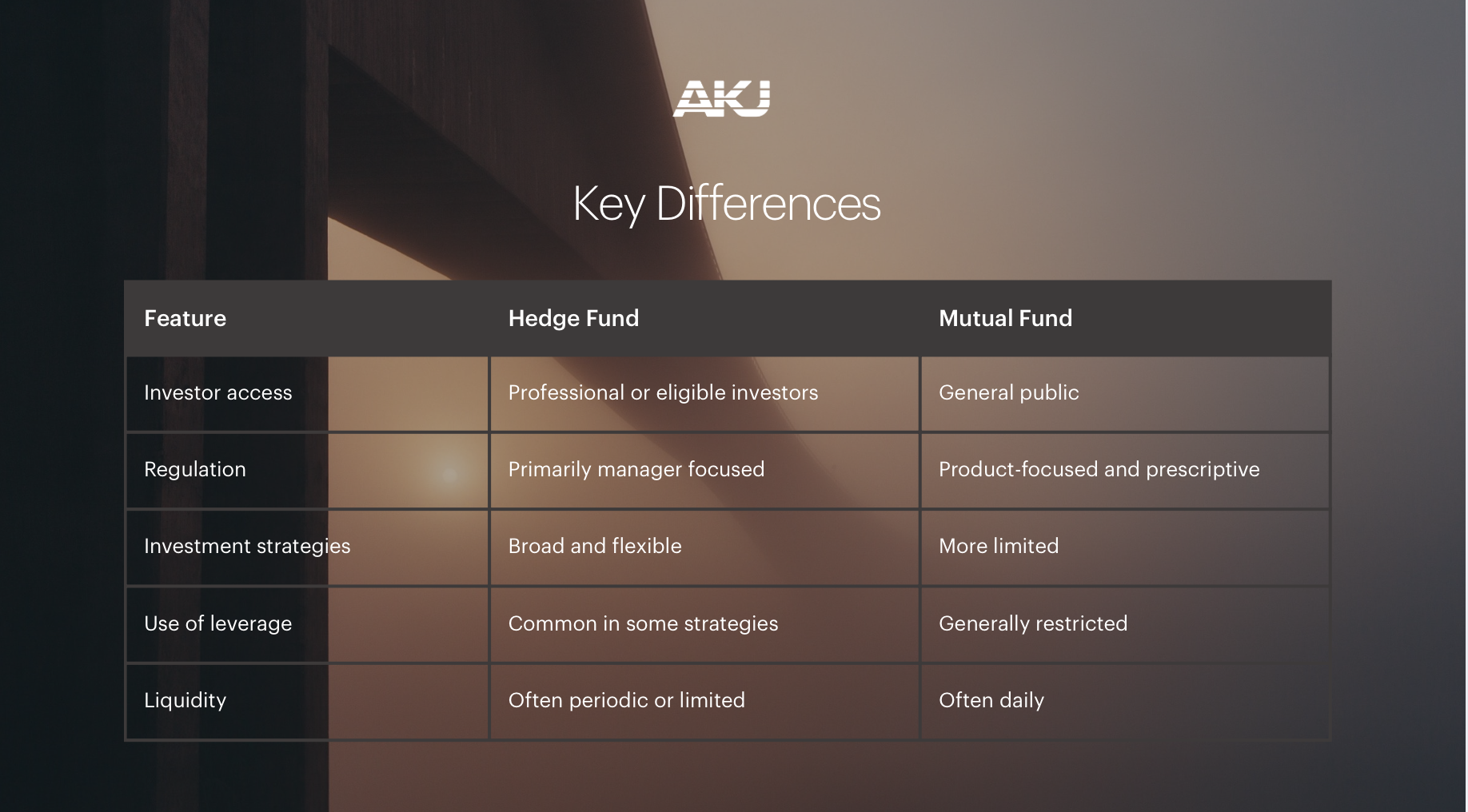
In broad terms, hedge funds prioritise flexibility and strategy diversification, while mutual funds prioritise accessibility and investor protection.
Pros and Cons of Investing in Hedge Funds
Investment in hedge funds can offer both potential advantages and material risks.
Potential advantages
- Access to a wider range of investment strategies
- Active management and tactical asset allocation
- Exposure to strategies that may perform differently from traditional equity or bond markets
- Potential for enhanced risk-adjusted returns relative to traditional benchmarks
Potential disadvantages
- Fee structures that are often higher than those of traditional funds
- Liquidity restrictions, including lock-up periods and limited redemption windows
- Limited availability to retail investors
- Strategies involving leverage or concentrated positions may carry an elevated risk of loss
For these reasons, hedge funds are generally considered more suitable for investors with the relevant experience, resources, and risk tolerance.
How to Invest in a Hedge Fund
Investing in a hedge fund usually requires an investor to satisfy certain eligibility criteria, such as qualifying as a professional client or high-net-worth individual under applicable regulatory standards.
Investment is commonly made through:
- Private placement arrangements
- Investment management firms
- Institutional or professional investment platforms
The process typically involves a combination of legal documentation, investor due diligence, and ongoing reporting and disclosure obligations.
How are Hedge Funds Regulated in the UK and EU?
In both the UK and European Union, regulatory oversight of hedge funds is primarily applied at the level of the manager rather than the fund itself.
In the UK, hedge fund managers are generally authorised and supervised by the Financial Conduct Authority (FCA) under the UK implementation of the Alternative Investment Fund Managers Directive (AIFMD).
Across the EU, hedge fund managers are regulated under the AIFMD framework, which establishes requirements relating to authorisation, capital adequacy, risk management, reporting, and investor disclosure. The directive is implemented and enforced by national regulators in each EU member state.
This regulatory approach is designed to promote investor protection and market stability while allowing a degree of flexibility in investment strategy.
In addition, depending on their legal form and domicile, certain fund vehicles may themselves be subject to authorisation or supervision by the relevant national regulator.
Hedge Funds and Professional Platforms
Operating a hedge fund requires not only investment expertise but also a robust legal, operational, and regulatory infrastructure.
Specialist platforms may assist hedge fund managers with fund structuring, regulatory compliance, operational processes, and governance arrangements.
Explore how AKJ supports hedge fund managers through its hedge fund platform and professional services
Conclusion: Understanding Hedge Funds
A hedge fund is a flexible investment structure used by professional investors and managed according to defined strategies within a regulatory framework.
An understanding of how hedge funds operate, how they differ from mutual funds, and how they are regulated can be useful for those exploring alternative investments.
*THIS IS NOT A LEGAL ANALYSIS NOR INVESTMENT ADVICE; IT IS PROVIDED FOR DESCRIPTIVE AND INFORMATIONAL PURPOSES ONLY.