What is Effective Risk Management in Crypto?
Effective risk management in crypto is the discipline of identifying, sizing, and containing protocol and market risks before they reach the portfolio — combining institutional infrastructure with quantitative portfolio controls. For UK and EU managers and investors, that framework now sits inside a defined regulatory fence: MiCA (EU) authorises crypto-asset service providers across member states, and the Financial Services and Markets Act (FSMA) brings cryptoassets within the FCA's regulatory remit. The question for managers is no longer whether to formalise a risk management framework — it is how to build one that holds during a real shock and protects investors. AKJ operationalises this framework end-to-end. Learn more about the AKJ Digital Fund Platform.
What Are the Main Types of Risk in Crypto?
Among the wide range of risks in all asset classes, crypto introduces certain risks that require careful management and utilising tools and software tailored for the purpose. This applies particularly to protocol risks because of the nature of crypto infrastructure, but also to market risk due to the nascent nature of crypto as an asset class and financial market.
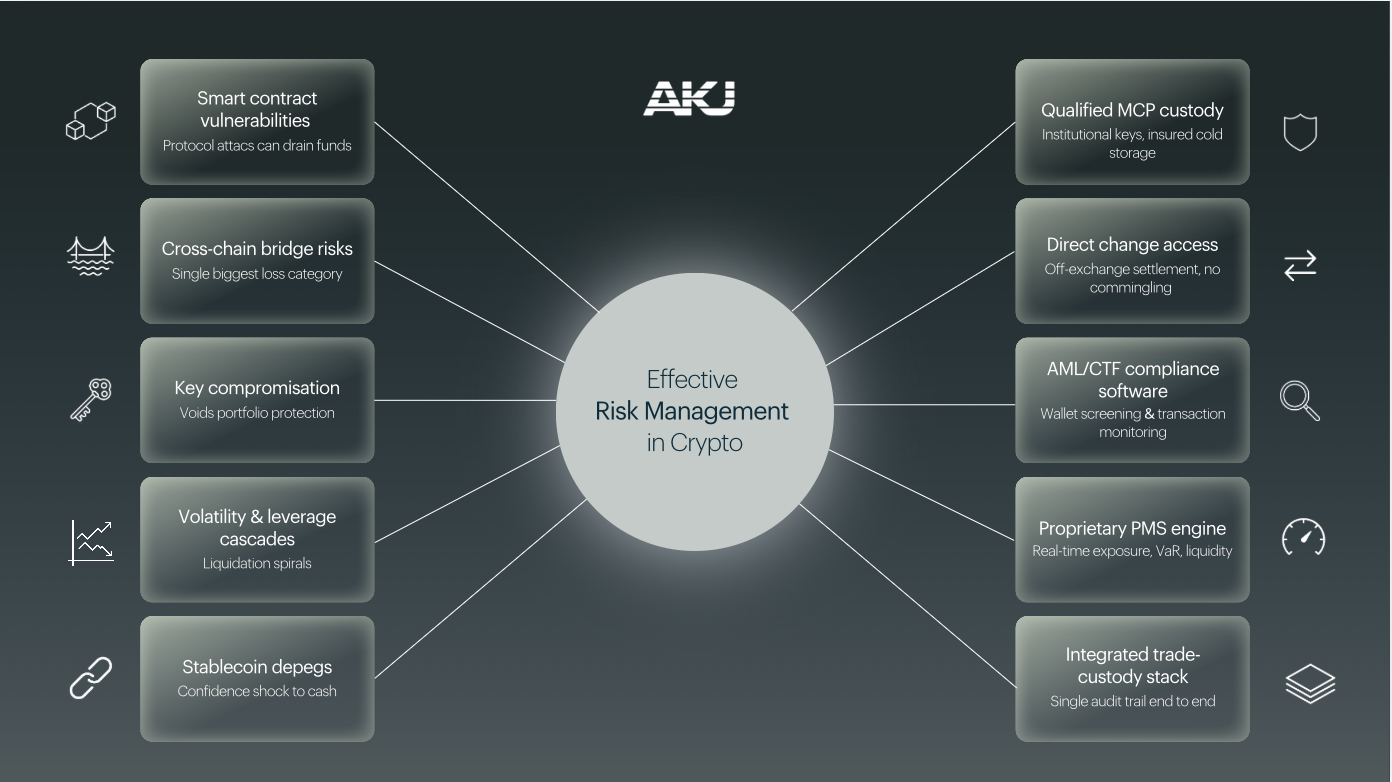
Protocol risks live inside the infrastructure itself — they require careful asset selection, venue diligence, and the right custody architecture. The main categories are:
- Smart contract vulnerabilities — attackers may alter protocol behaviour and drain funds, especially in DeFi.
- Cross-chain bridge risks — the single biggest loss category, where exploited attestation mechanisms have repeatedly drained funds.
- Key compromise — without appropriate custody, a single compromised key can render even the best portfolio protection invalid.
- Protocol-layer changes — consensus shifts and governance changes that can rarely be prevented without disciplined asset selection.
Market risks fall to the portfolio manager and require proactive discipline. The main categories are:
- Volatility and leverage cascades — can induce liquidation spirals across the stack.
- Stablecoin depegs — a narrative and confidence risk to the portfolio's cash allocation.
- Regulatory risk — sub-sector enforcement actions can dry up liquidity overnight.
These risks are not hypothetical scenarios; cases like the Ronin bridge exploit and the Drift protocol compromise inflicted enormous losses on investors, and systemic risk events like the crash on 10th October 2025 with liquidations and a USDe stablecoin depeg to $0.65 demonstrates the need to carefully navigate these risks one way or another.
Why do protocol risks deserve as much attention as market risks?
Because protocol-layer losses — bridge exploits, key compromises, exchange failures — historically dwarf the cumulative impact of market drawdowns in crypto. Ronin, FTX, Celsius and the 2025 Drift compromise together erased more capital than any single market move. Market risk can be modelled and sized; protocol risk has to be engineered away through custody architecture and venue diligence before a position is even taken.
Crypto Risk Management Strategies: What If This Happens?
The clearest test of a risk management framework is whether it would have helped in the events that actually happened. The table below maps the major crypto market shocks of the past three years to the action that would likely have contained the loss.
What Are the Main Risk Management Tools for Crypto?
Two layers of defence: infrastructure and portfolio construction
Protocol risks can be largely engineered away through the right infrastructure; market risks can only be survived through disciplined portfolio and risk management.
Infrastructure tools (to engineer protocol risks away):
- Qualified custody — segregated client wallets, MPC or multi-signature cold storage, no rehypothecation.
- Counterparty diligence and venue monitoring — continuous wallet, exchange, and proof-of-reserves surveillance.
- AML/CTF screening — automated wallet screening, sanctions monitoring, travel-rule infrastructure.
- Smart-contract and protocol scoring — audit-quality grading, admin-key configuration, oracle architecture.
Portfolio management tools (to survive market risks):
- Exposure and concentration limits — enforced at the platform level, not by manual policy.
- Value-at-Risk and expected shortfall — daily quantification of portfolio risk against the risk budget.
- Scenario and stress testing — named-scenario impact analysis (BTC drawdown, stablecoin depeg, exchange halt).
- Sophisticated execution — TWAP/VWAP routing, smart venue selection, depth-calibrated trade sizing, hedging instruments.
AKJ integrates both layers into one regulated stack — read about how the AKJ Digital Fund Platform brings crypto trading risk management (custody, execution and monitoring) into a single accountable framework.
How to Implement Effective Risk Management in Crypto: Step-by-Step
Effective risk management runs as a four-phase operational flow — define, implement, execute, monitor — applied consistently across the portfolio's lifecycle.
- Define the risk budget. Set maximum portfolio drawdown, and define concentration, leverage and per-position loss limits.
- Implement the infrastructure. Select institutional-grade solutions across three categories: qualified custody (segregated client wallets, cold storage with MPC or multi-sig), AML/CTF screening (pre-execution wallet screening, sanctions monitoring), and DeFi protocol scoring (rating audit quality, admin-key configuration, and oracle architecture).
- Execute intelligently. Run a documented best-execution policy across trading operations — TWAP or VWAP routing, smart venue selection, depth-calibrated trade sizing, and pre-trade slippage and liquidity checks for sized trades; stop-loss and trailing-stop orders, pre-defined profit-taking rules, and derivative instruments used where appropriate to hedge specific risks.
- Monitor portfolio risk continuously. Focus on daily VaRs, expected shortfall, and stress tests, supported by post-trade transaction-cost analysis and exception monitoring across the trading book. Use the outputs to set position limits before the fact and to trigger de-risking when results breach thresholds; review and rebalance on a defined cadence.
AKJ runs this flow as a single regulated stack — define, implement, execute, and monitor inside one accountable framework.
Summary
Effective risk management in crypto is the discipline of identifying, sizing, and containing protocol and market risks before they reach the portfolio — through the right infrastructure and disciplined portfolio management using sophisticated toolsets. Doing this in a regulatory fence (such as MiCA and FCA) enables institutional-quality asset management.
AKJ delivers all of this through one integrated, regulated stack — qualified custody, continuous monitoring, and disciplined execution under a single accountable framework inside the UK and EU regulatory fence. Learn more about the AKJ Digital Fund Platform, read about market signals in our guide to the Best Crypto Indicators, or contact us to discuss your portfolio.